🎵 Everyday phenomenon – sound & radio waves
Stand near a tall building and listen to a street musician around the corner – you hear the music clearly because sound waves diffract (spread) around obstacles. Long‑wave radio signals reach valleys behind mountains, but short‑wave TV signals cannot – diffraction is strongest when the obstacle/gap size is comparable to the wavelength.

⚡ Diagnostic quick‑check
📐 Key definitions
Coherence: two sources emit waves with same frequency and constant phase difference.
Path difference: difference in distance from a point to two sources.
Constructive interference: path difference = nλ → waves in phase → bright fringe.
Destructive interference: path difference = (n+½)λ → waves out of phase → dark fringe.

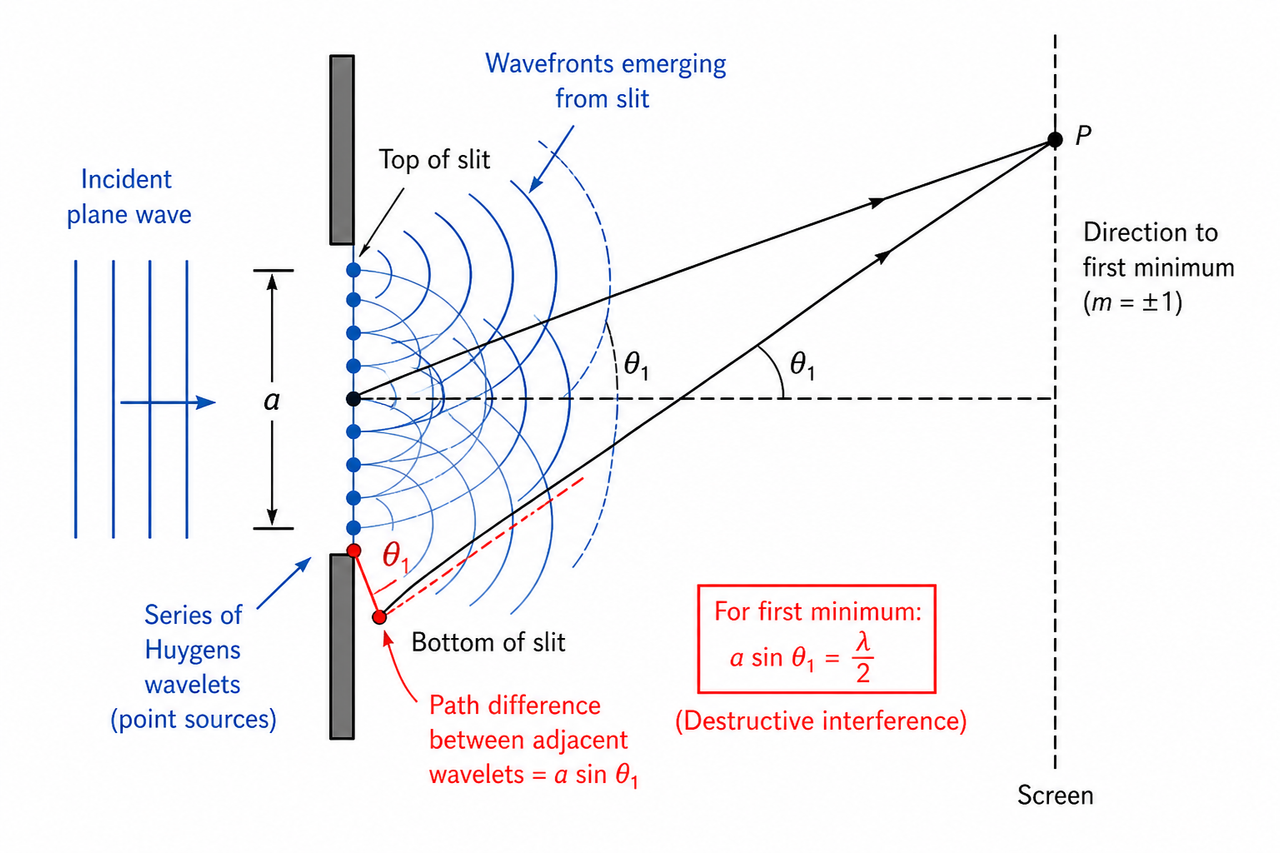
🔬 Introducing single‑slit diffraction
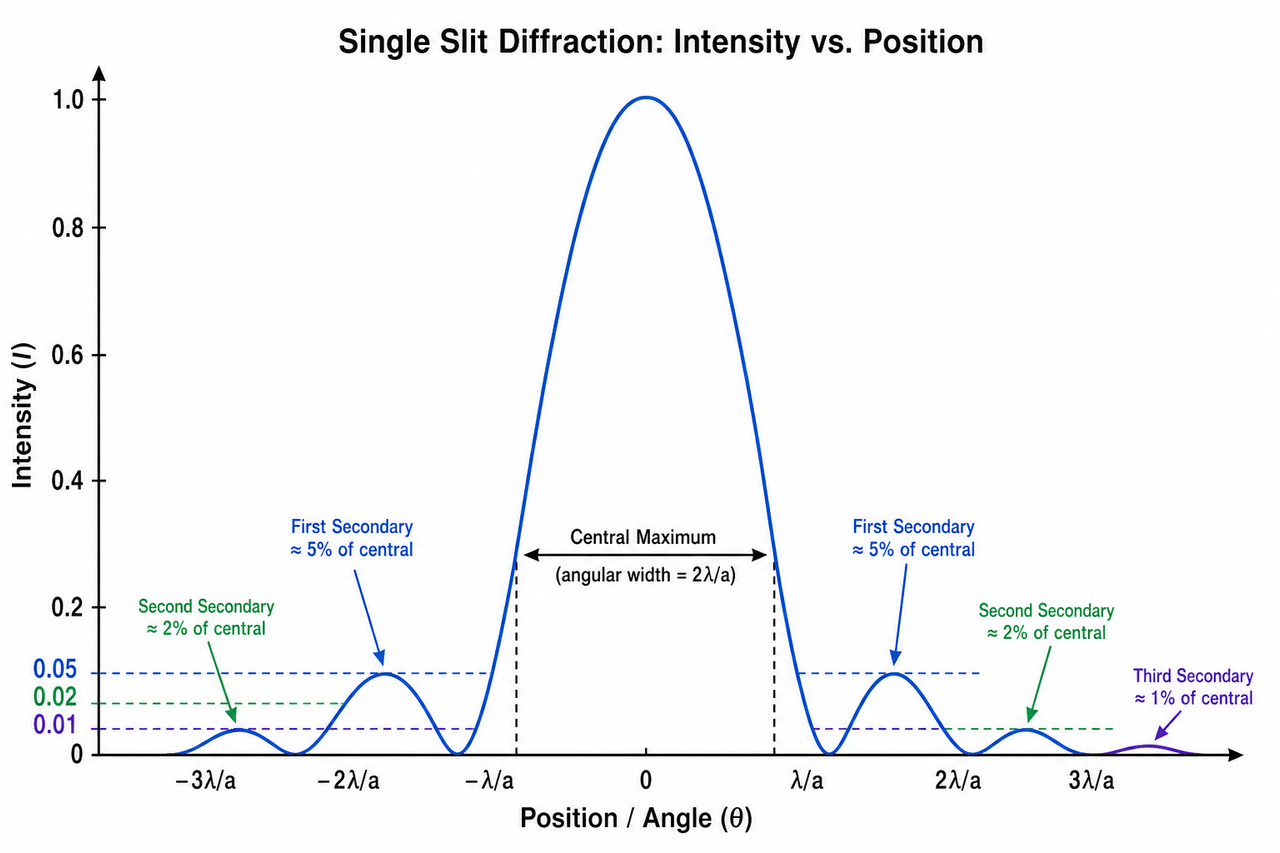
When light passes through a very narrow slit, it does not travel in a straight line but spreads out. According to Huygens, every point across the slit emits wavelets that interfere. The result is a pattern of a very bright central maximum flanked by dimmer secondary maxima, separated by completely dark minima.

❓ Why minima occur – pairing wavelets
For the first dark fringe at angle θ₁, take wavelets from the top edge and the midpoint of the slit. If their path difference is λ/2, they cancel. Geometry: (b/2) sinθ₁ = λ/2 → sinθ₁ = λ/b. Extending to the whole slit gives the general condition for minima:
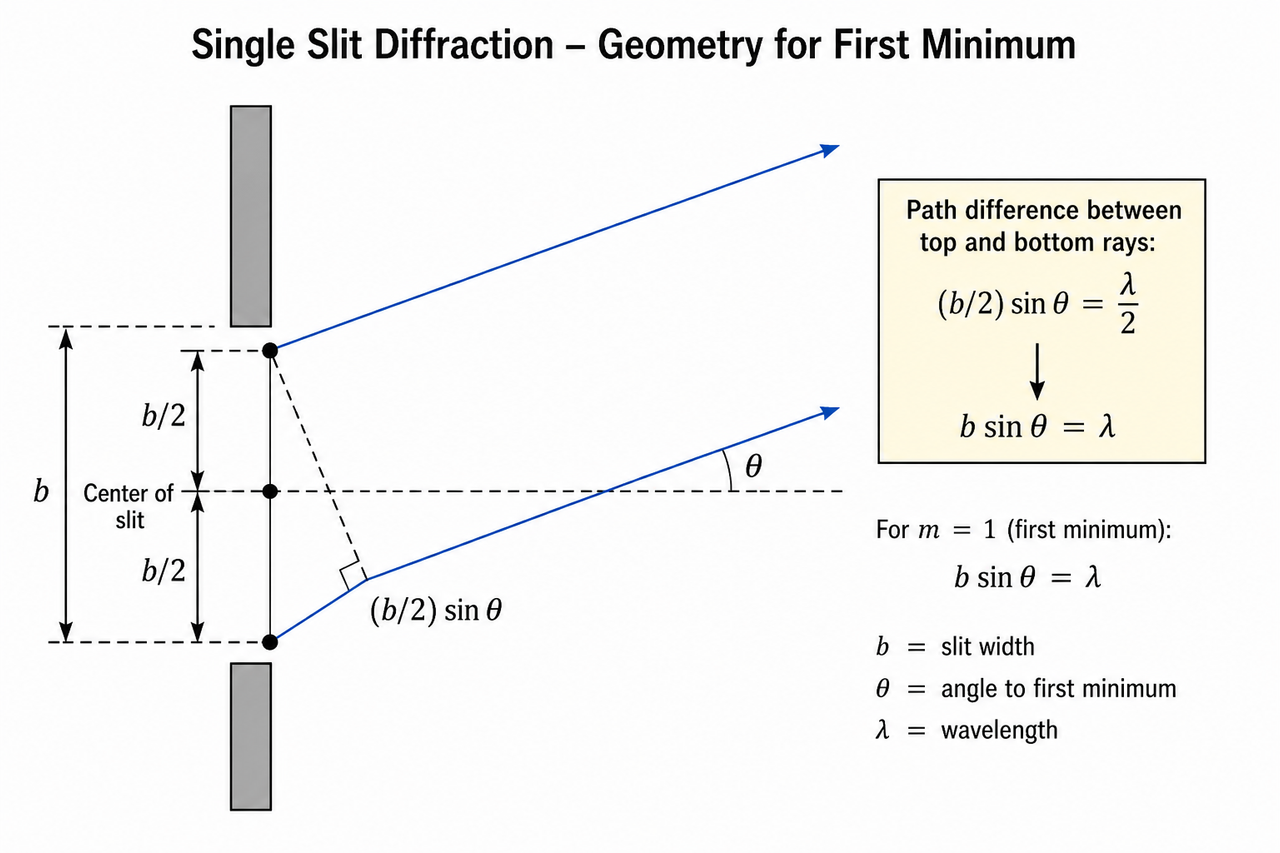
🔑 Single‑slit minima condition
Linear width of central maximum on a screen: \( w = \frac{2\lambda D}{b} \) (for small angles).
Proportionalities: θ₁ ∝ λ and θ₁ ∝ 1/b. Narrower slit → wider pattern. Longer λ → wider pattern.
🧪 Single‑slit diffraction explorer
💡 What to notice: Drag slit width – narrower → wider central peak but much dimmer. Change colour: red (long λ) spreads more than blue. Double D → pattern on screen doubles in size (angle unchanged).
📝 Worked Example 1 – Finding slit width (IB style)
📝 Worked Example 2 – Effect of wavelength change
Same slit (0.033 mm) but λ changes to 650 nm. Find new first minimum distance at D=2.50 m.
📈 Linearising graphs – exam tricks
Plotting θ₁ (rad) against 1/b (mm⁻¹) gives a line through origin with slope = λ (in metres). Also w (central max width) vs D gives slope = 2λ/b.
✍️ Fill in the blanks
As the slit width is reduced, the diffraction pattern becomes and the peak intensity .
(i) Calculate the angle of the first minimum.
(ii) Determine the slit width.
(iii) The slit is replaced by one half the width. State and explain what will happen to the width of the central maximum and its brightness. [5 marks]
✓ (ii) b = λ/θ = 633×10⁻⁹ / 3.5×10⁻³ = 1.81×10⁻⁴ m = 0.18 mm.
✓ (iii) Central maximum doubles in linear width (θ ∝ 1/b). Brightness drops to about one‑quarter because amplitude halves ⇒ intensity ∝ amplitude².
❌ “Diffraction is separate from interference”
✅ Single‑slit diffraction is interference of many wavelets from the same slit.
❌ “Wider slit → wider pattern”
✅ Wider slit → narrower pattern because θ₁ = λ/b decreases.
❌ “b sinθ = nλ gives bright fringes”
✅ This equation gives dark fringes (minima). Bright maxima are approximately halfway between.
❌ “Changing screen distance changes angles”
✅ Angles depend only on b and λ; D only changes linear size on screen.
Central maximum contains >90% of energy. First side peak ≈5% of central. Narrow slit → wide, dim pattern; long λ → wide pattern.