A.3 SL/HL Concept 1 of 5

Work Done by a Force

Part of A.3 Work, Energy and Power · Unit A — IB Physics 2023

1 Lesson 1 of 5 · A.3 Work, Energy and Power
Work Done by a Force
A weightlifter holding 200 kg overhead is doing no work at all. Physics uses the word far more narrowly than everyday speech does.

🎯 Hook – the weightlifter who does nothing

A weightlifter holds a loaded barbell motionless above their head. Their muscles burn, they are exhausted, and by any everyday measure they are working extremely hard. In physics, the mechanical work done on the barbell is exactly zero — because the barbell does not move.

The Moon is a stranger case. Gravity pulls on it constantly and it moves constantly, yet gravity does no work on it either, because the pull is always perpendicular to the motion. This is why a satellite needs no engine to stay in orbit.

A weightlifter holding a barbell overhead with a large upward force arrow and a zero displacement label, beside the Moon orbiting Earth with the gravitational force perpendicular to its motion
Fig 1 — Two ways to get zero work: no displacement, or force perpendicular to displacement.
💡 Diagnostic question (think – then read on) — You carry a heavy suitcase horizontally along a level corridor at steady speed. How much work do you do against gravity? None. The upward force you exert is perpendicular to the horizontal displacement.

📐 Defining work

Work is the energy transfer that occurs when a force moves an object. We say work is done on the object by the force. Only the component of the force along the line of displacement counts, so the general definition includes the angle \(\theta\) between the force and the direction of motion.

Work done by a constant force $$W = Fs\cos\theta \qquad \text{SI unit: joule, J}$$

One joule is the work done when a force of 1 N moves through a distance of 1 m, so 1 J = 1 N m. Because work is a transfer of energy, it is measured in the same unit as energy, and energy itself is defined as the ability to do work.

A block on a surface pulled by a force F at angle theta to the horizontal, with the horizontal component F cos theta and displacement s labelled
Fig 2 — \(\theta\) is the angle between the force and the direction of motion. Only \(F\cos\theta\) does work.

When the force acts in the same direction as the motion, \(\theta = 0\) and \(\cos\theta = 1\), so the equation reduces to the familiar \(W = Fs\).

Angle \(\theta\)\(\cos\theta\)Work doneExample
0°+1Maximum positive, \(W = Fs\)Pushing a trolley forwards
Between 0° and 90°Between 0 and 1Positive but reducedPulling a box by a sloping rope
90°0ZeroGravity on an orbiting Moon; carrying a case on the level
180°−1Negative, \(W = -Fs\)Friction on a sliding block; braking
✓ Examiner tip: negative work means energy is being taken out of the object's motion. Friction and air resistance always do negative work on a moving body.

✍️ Worked example – dragging a box at an angle

1
Identify: A 150 kg box is pulled 2.27 m across horizontal ground by a 248 N force. Find the work done (a) when the force is horizontal, and (b) when the same 248 N acts at 20.0° above the horizontal.
2
Data: \(F = 248\ \text{N}\), \(s = 2.27\ \text{m}\), \(\theta = 0\) then \(\theta = 20.0°\). The mass is not needed — work depends on the force applied, not on the mass being moved.
3
Equation: (a) \(W = Fs = 248 \times 2.27\). (b) \(W = Fs\cos\theta = 248 \times \cos 20.0° \times 2.27 = 248 \times 0.940 \times 2.27\).
4
Answer: (a) \(W = 563\ \text{J}\). (b) \(W = 529\ \text{J}\) — less work, because only the horizontal component contributes.
A 150 kg box on horizontal ground pulled by a 248 N force at 20 degrees above the horizontal, with the displacement of 2.27 metres marked
Fig 3 — Tilting the rope up does less work over the same distance, yet it may still be the easier way to move the box.
💡 Why pull at an angle at all? The vertical component reduces the normal contact force, which reduces friction — so the box may slide more easily even though the applied force does less work per metre.

📈 Work done by varying forces

The equation \(W = Fs\cos\theta\) assumes a single constant force, but real forces rarely stay constant. For a varying force the work done is found from a force–distance graph:

Varying force $$W = \text{area under the force–distance graph}$$

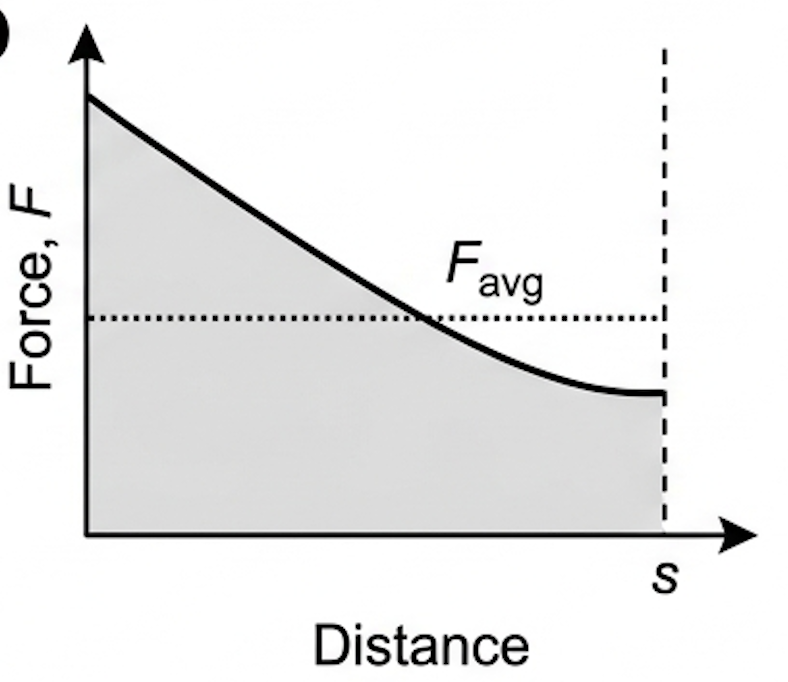
In practice you estimate the average force by eye — draw a horizontal line so that the area of the rectangle beneath it matches the area under the curve. Then \(W = F_{\text{avg}}s\).

Graph typeAxes (X, Y)ShapeWhat to read
Force–distanceDistance \(s\), force \(F\)Any curveArea under the graph = work done
Average force lineDistance \(s\), force \(F\)Horizontal line of equal areaIts height is \(F_{\text{avg}}\); \(W = F_{\text{avg}}s\)
Force–extension (Hooke's law spring)Extension \(x\), force \(F\)Straight line through the originTriangular area, \(W = \tfrac{1}{2}Fx\)
Force against distance graph with a curved decreasing line, the area under it shaded, and a dotted horizontal average force line
Fig 4 — The dotted line is the average force, judged so the rectangle matches the shaded area.
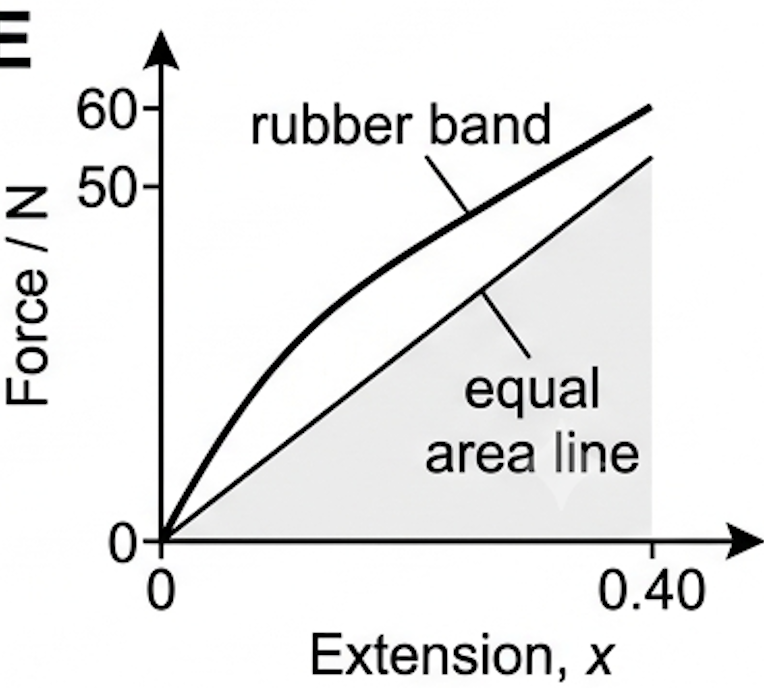
Force against extension graph for a rubber band, a curved blue line to 60 newtons at 0.40 metres with a straight red equal-area line
Fig 5 — Rubber under tension. The straight line has the same area, giving \(W = \tfrac12 \times 50 \times 0.40 = 10\) J.
✓ For a spring obeying Hooke's law the graph is a straight line, so the average force is simply half the final force — no eye-judgement needed.

🔬 Nature of science: same words, different meanings

Physics terms have precise meanings that often clash with everyday usage. "Work", "energy", "power", "momentum", "heat", "efficiency" and "interference" all mean something narrower in physics than in conversation.

There is no connection between \(W = Fs\cos\theta\) and "I have a lot of homework tonight". Recognising which sense of a word a question is using is part of learning the subject.

💪 Where does the effort go?

The weightlifter is not cheating thermodynamics. No work is done on the barbell, but work is done inside their muscles, where fibres repeatedly contract and relax to hold position. That energy leaves the body as thermal energy.

⚠️ Be precise in exam answers: say "no work is done on the weights", not "no work is done".

⚠️ Trap corner – common mistakes

MisconceptionCorrect view
If you exert a force you must be doing workWork needs displacement. A stationary object has zero work done on it however large the force.
\(\theta\) is the angle between the force and the horizontal\(\theta\) is the angle between the force and the direction of motion. These coincide only when the motion is horizontal.
Work is always positiveA force opposing the motion does negative work. Friction removes energy from the moving object.
Use the total distance travelledUse the displacement in the direction of the force. A body returning to its starting point has zero net work done by a constant force.
The gradient of a force–distance graph gives the workThe area gives the work. The gradient has no standard meaning here.
Heavier objects always need more work to moveWork is force × displacement. On a friction-free horizontal surface, mass does not appear in the calculation at all.
⚠️ Most common slip: using \(\sin\theta\) instead of \(\cos\theta\), which happens whenever the angle is measured from the wrong reference line. Sketch the force and the displacement before substituting.
W = Fs cos θ 1 J = 1 N m θ = 90° ⟹ W = 0 friction does negative work area under F–s graph = W spring: W = ½Fx
Practice check — multiple choice
1. A force of 30 N pulls a crate 4.0 m along the floor at 60° to the horizontal direction of motion. The work done by the force is
A 0 J
B 60 J
C 104 J
D 120 J
2. A satellite travels in a circular orbit at constant speed. The work done on it by the gravitational force during one complete orbit is
A zero, because the force is always perpendicular to the motion
B zero, because gravity is too weak at that distance
C positive, because the satellite keeps moving
D negative, because the satellite is pulled inwards
3. A spring obeying Hooke's law is stretched by a force rising steadily from 0 to 24 N, extending 12 cm. The work done on the spring is
A 0.72 J
B 1.4 J
C 2.9 J
D 288 J
4. Which situation involves negative work being done on the object?
A A crane lifting a girder upwards
B A waiter carrying a tray horizontally at steady speed
C Friction acting on a book sliding across a table
D Gravity acting on a falling apple
Practice check — fill in the blanks

Complete the statements:

Work done equals the force multiplied by the in the direction of the force. Its SI unit is the , equal to one newton . If the force is perpendicular to the motion the work done is . For a varying force, the work done is given by the under a force–distance graph.
Exam‑style questions
Exam question · Define / Calculate
(a) Define the work done by a force. [2]
(b) Calculate the work done in lifting an 18 kg suitcase through a vertical height of 1.05 m at constant speed. [2]
(c) Calculate the work done in pushing the same suitcase 1.05 m horizontally against an average frictional force of 37 N. [1]
5 marks
(a) ✓ The product of the force and the displacement moved ✓ in the direction of the force (\(W = Fs\cos\theta\)).
(b) ✓ At constant speed the lifting force equals the weight, \(F = mg = 18 \times 9.8 = 176\ \text{N}\). ✓ \(W = 176 \times 1.05 = 185\ \text{J}\).
(c) ✓ \(W = 37 \times 1.05 = 39\ \text{J}\).
Exam question · Calculate / Explain
A gardener pushes a lawnmower at a constant speed of 0.85 m s⁻¹ with a force of 70 N directed at 40° to the ground.
(a) Calculate the component of the force in the direction of motion. [1]
(b) State the magnitude of the frictional force, and explain your reasoning. [2]
(c) Determine the work done in moving the lawnmower for 3.0 s. [3]
6 marks
(a) ✓ \(F\cos 40° = 70 \times 0.766 = 54\ \text{N}\).
(b) ✓ 54 N. ✓ The speed is constant, so the resultant horizontal force is zero and friction must balance the horizontal component of the push.
(c) ✓ \(s = vt = 0.85 \times 3.0 = 2.55\ \text{m}\). ✓ \(W = Fs\cos\theta = 54 \times 2.55\). ✓ \(W = 137 \approx 1.4 \times 10^{2}\ \text{J}\).
Exam question · Explain / Graph
(a) A weightlifter holds a 180 kg barbell motionless above their head for 4.0 s. Explain why no work is done on the barbell, and why the weightlifter nevertheless becomes tired. [3]
(b) A car of mass 1200 kg travels at constant speed for 1.4 km, during which 2.3 × 10⁶ J of work is done against resistive forces. Calculate the average resistive force. [2]
5 marks
(a) ✓ Work requires a displacement in the direction of the force; the barbell does not move, so \(s = 0\) and \(W = 0\). ✓ Muscle fibres repeatedly contract and relax to maintain the position. ✓ Work is done internally in the muscles and the energy is transferred as thermal energy, so the lifter tires.
(b) ✓ \(F = W/s = 2.3\times10^{6} / 1400\). ✓ \(F = 1.6\times10^{3}\ \text{N}\).
Score: 0 pts