🎯 Hook – Aristotle was wrong for two thousand years
"Forces are needed to keep an object moving and, without those forces, movement will stop." That accepted fact was the basis of theories of motion from Aristotle, about 2350 years ago, until the seventeenth century. It is not true — and it is still widely believed. What actually stops moving objects is friction, not the absence of a driving force.

📐 First law: equilibrium and inertia
Newton's first law of motion states that an object will remain at rest or continue to move in a straight line at a constant speed, unless a resultant force acts on it. In other words, a resultant force will produce an acceleration — a change in velocity.
When the influences on a system are balanced so that the system does not change, we describe it as being in equilibrium. When there is no resultant force on an object, we say it is in translational equilibrium: it remains at rest or continues to move with a constant velocity. The term translational refers to movement from place to place.
Because all objects on Earth have weight, no object is in equilibrium through having no forces on it. All translational equilibrium arises when two or more forces are balanced:
| Situation | What balances what |
|---|---|
| Book on a table | Downwards weight balanced by the upwards normal contact force |
| Block resting on a slope | Component of weight down the slope balanced by friction up the slope; component into the slope balanced by the normal contact force |
| Cyclist at constant speed | Weight balanced by the two normal contact forces; drag balanced by the frictional force from the road |
| Ball at terminal speed | Weight balanced by air resistance, which has grown with speed until it is equal and opposite |
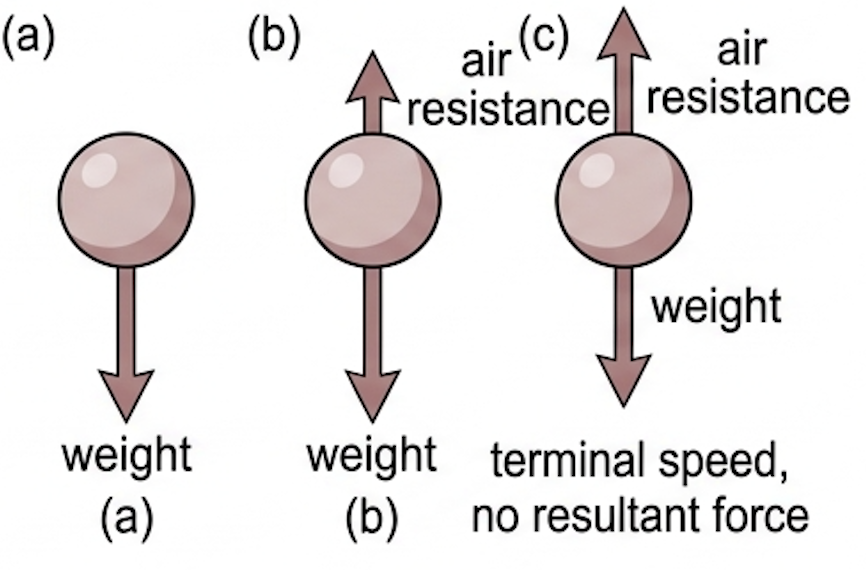
If two forces acting on an object do not produce equilibrium, a third force can be added that is equal in size to the resultant of the other two but in the opposite direction. All three forces must act through the same point.
⚖️ Second law: F = ma
The first law establishes that resultant force and acceleration are connected. Newton's second law gives the mathematical connection: when a resultant force acts on a constant mass, the acceleration is proportional to the resultant force, \(a \propto F\). Both are vectors, and the acceleration is in the same direction as the force.
Experiments also show that for the same resultant force on different masses, the acceleration is inversely proportional to the mass: \(a \propto 1/m\). Combining these, \(a \propto F/m\), so \(F \propto ma\). Defining the newton as the force that accelerates 1 kg by 1 m s⁻²:
This version assumes the mass is constant; a version allowing for changing mass comes later in this topic. For a gravitational force the acceleration involved is \(g\), so \(F = ma\) becomes the familiar:
The second law also gives a different way of understanding mass. Larger masses accelerate less than smaller masses under the same resultant force, so mass is a measure of an object's resistance to acceleration. Physicists use the term inertia for an object's resistance to a change of motion: mass is a measure of inertia.
↔️ Third law: forces come in pairs
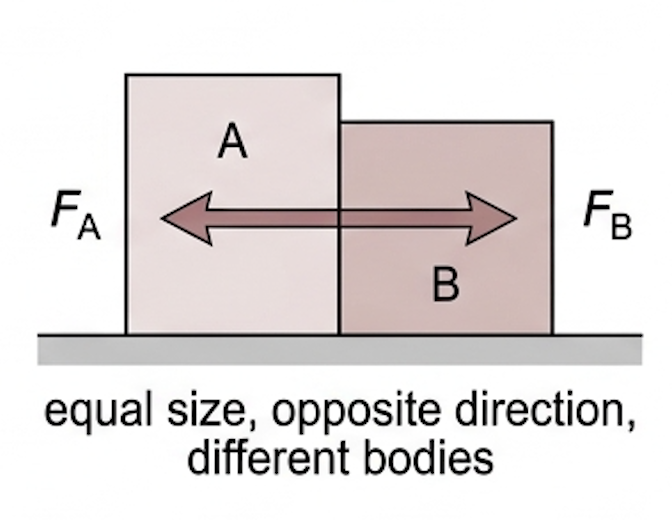
Newton's third law of motion states that whenever one body exerts a force on another body, the second body exerts a force of the same magnitude on the first body, but in the opposite direction. Newton's own phrasing: to every action there is an equal and opposite reaction.
Forces therefore always occur in equal pairs — but the two forces act on different bodies, so only one of each pair can appear in any free-body diagram. The two forces are always of the same type: gravity with gravity, friction with friction. In everyday terms, it is not possible to push something that does not push back on you.
| If… | then… |
|---|---|
| you pull a rope | the rope pulls you |
| the Earth pulls a person | the person pulls the Earth |
| you push on the ground | the ground pushes on you |
| an aircraft pushes down on the air | the air pushes up on the aircraft |
| the Sun attracts the Earth | the Earth attracts the Sun |
📈 Graphs every examiner uses
| Graph type | Axes (X, Y) | Shape | What to read |
|---|---|---|---|
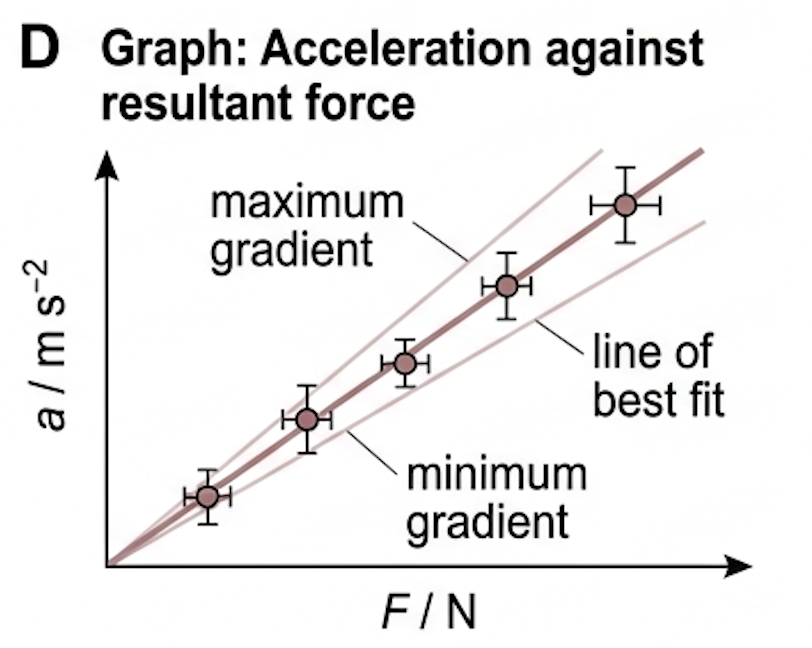
| Acceleration against force (constant \(m\)) | \(F\), \(a\) | Straight line through the origin | Gradient \(= 1/m\), so the mass is the reciprocal of the gradient |
| Acceleration against \(1/m\) (constant \(F\)) | \(1/m\), \(a\) | Straight line through the origin | Gradient = the resultant force applied |
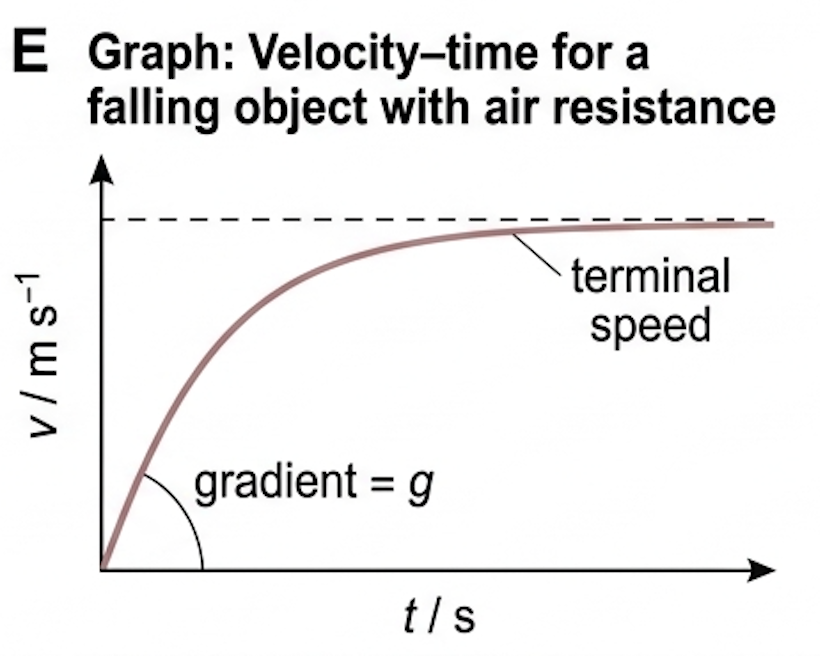
| Velocity–time for a falling body with drag | \(t\), \(v\) | Curve of decreasing gradient, levelling off | The plateau is the terminal speed; the initial gradient is \(g\) |
| Extension against force (spring) | \(F\), length | Linear but not through the origin | Gradient = force constant; horizontal intercept = original length |
✍️ Worked example – accelerating a car
A car of mass 1450 kg is accelerated from rest by an initial resultant force of 3800 N. Calculate its acceleration, its speed after 4.0 s, the distance travelled in that time, and the force needed to maintain the same acceleration once resistive forces reach 1800 N.

🔧 Real-world: crumple zones and sand pits
A long jumper lands in sand because the sand extends the duration of the impact. The same change in velocity spread over a longer time means a smaller deceleration and, by \(F = ma\), a smaller force on the athlete. Car crumple zones, air bags and seat belts all work the same way.
🚀 HL Extension – pulleys and connected masses
Treat two connected masses as one system: the resultant force is the difference in the weights, and the mass is their sum. For 500 g and 100 g over a frictionless pulley, \(F = (0.500 - 0.100)(9.8) = 3.9\ \text{N}\) and \(a = 3.9/0.600 = 6.5\ \text{m s}^{-2}\).
Challenge: find the tension in the string. (Answer: for the 100 g mass, \(T - 0.98 = 0.100 \times 6.5\), so \(T = 1.6\ \text{N}\) — the same from either mass)
⚠️ Trap corner – common mistakes
| Misconception | Correct view |
|---|---|
| A moving object must have a force pushing it along | Constant velocity means zero resultant force. Force causes acceleration, not motion. |
| The force when an object hits the ground is its weight | The impact force depends on the duration of the collision. A shorter impact gives a larger force. |
| Weight and normal contact force are a third-law pair | They act on the same body and are different types of force. A third-law pair acts on two different bodies. |
| In \(F = ma\), \(F\) is the applied force | \(F\) is the resultant force. Subtract friction and drag before dividing by the mass. |
| Equal and opposite forces must have equal effects | A fist and a cheek feel the same magnitude of force, but the damage depends on area, duration and what is being deformed. |
Complete the statements:
✓ (b) \(F = ma = 0.120 \times 18\) ✓ \(= 2.2\ \text{N}\)
✓ (c) For the steel ball \(a = 8.0/0.080 = 100\ \text{m s}^{-2}\) and \(F = 1.20 \times 100 = 120\ \text{N}\) ✓ the mass is ten times greater and the impact time is about five times shorter ✓ so by \(F = ma\) the force is roughly fifty times larger, and it acts over a small contact area.
✓ (b) \(F = ma = 520 \times 2.25\) ✓ \(= 1.2 \times 10^3\ \text{N}\) (1170 N)
✓ (c) The engine must also overcome drag and rolling friction — 1170 N is the resultant force, not the applied force.
✓ (b) The gravitational force of the person on the Earth ✓ equal in magnitude to the person's weight ✓ directed upwards (towards the person) and acting on the Earth, not on the person.
✓ (c) The air bag increases the time over which the passenger's velocity is reduced to zero ✓ so the deceleration is smaller ✓ and since \(F = ma\) the force on the passenger is smaller. It also spreads that force over a larger area.