A.2 Forces and Momentum · Lesson 1 of 5 · SL/HL
Newton’s Laws of Motion
A.2 — Newton’s three laws of motion; translational equilibrium; F = ma for constant mass; mass as inertia.
φQ PhysicsRevision sheet
Key ideas
- Aristotle was wrong. Forces are not needed to keep an object moving. What stops moving objects is friction.
- First law. An object stays at rest or moves in a straight line at constant speed unless a resultant force acts on it.
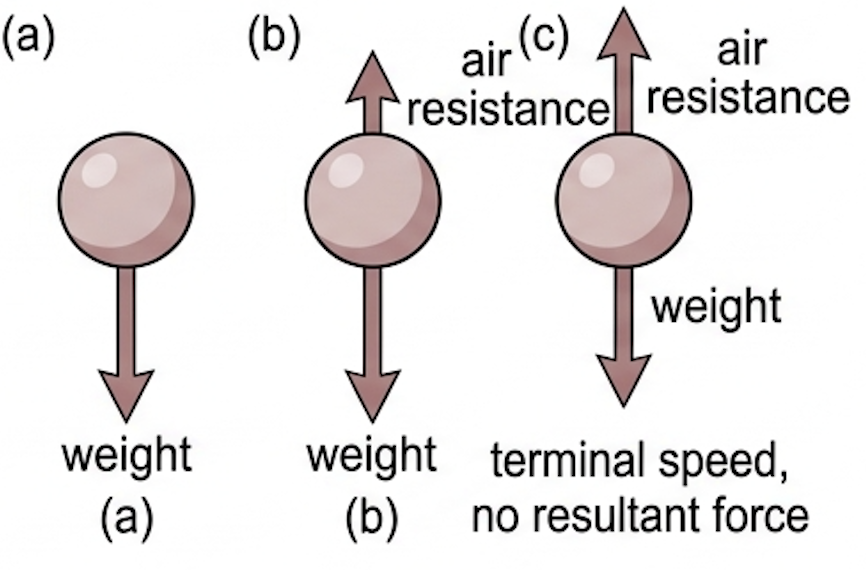
- Translational equilibrium. No resultant force: at rest or constant velocity. On Earth it always comes from two or more balanced forces.
- Second law. a ∝ F and a ∝ 1/m, so F = ma (constant mass). 1 N accelerates 1 kg by 1 m s⁻².
- Mass is inertia. Mass measures an object’s resistance to a change of motion.
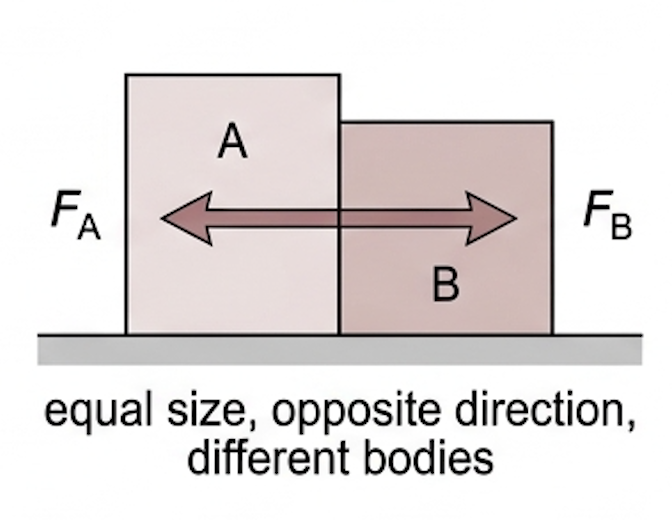
- Third law. If A exerts a force on B, B exerts an equal and opposite force on A: same type, different bodies.
- Impact time. A longer collision means a smaller deceleration and force: sand pits, air bags, crumple zones.
Common mistakes
- ✗A moving object needs a force pushing it.✓Constant velocity means zero resultant force.
- ✗Impact force equals weight.✓It depends on the duration of the collision.
- ✗Weight and normal force are a third-law pair.✓Same body, different types: not a pair.
- ✗In F = ma, F is the applied force.✓F is the resultant force.
- ✗Equal and opposite forces have equal effects.✓Damage depends on area, duration and material.
Equations
F = ma
F resultant force / N · m / kg · a / m s⁻²
Fg = mg
weight / N
FA = −FB
third-law pair, on different bodies
Graphs to know
| Graph | Shape | Read |
|---|---|---|
| a–F (constant m) | straight through origin | gradient = 1/m |
| a–1/m (constant F) | straight through origin | gradient = F |
| v–t with drag | gradient falls, levels off | plateau = terminal speed; initial gradient g |
Worked example
Accelerating a car
- m = 1450 kg, resultant F = 3800 N, from rest.
- a = 3800 ÷ 1450 = 2.62 m s⁻²; after 4.0 s, v = 10.5 m s⁻¹, s = 21.0 m.
- With 1800 N resistance: driving force = 3800 + 1800 = 5600 N for the same a.
HL pulley: 500 g and 100 g, a = 3.9 ÷ 0.600 = 6.5 m s⁻², T = 1.6 N.
Key figures