A.3 Work, Energy and Power · Lesson 3 of 5 · SL/HL
Conservation of Mechanical Energy
With no frictional resistive forces, total mechanical energy is conserved; work is the energy transformed between Ek, Ep and EH. HL: conservative forces and F = −dEp/dx.
φQ PhysicsRevision sheet
Key ideas
- The condition. Ek + Ep + EH = constant only when no frictional forces act. Total energy is always conserved.
- Conservative forces. Conserve mechanical energy; their work between two points is independent of path (e.g. gravity).
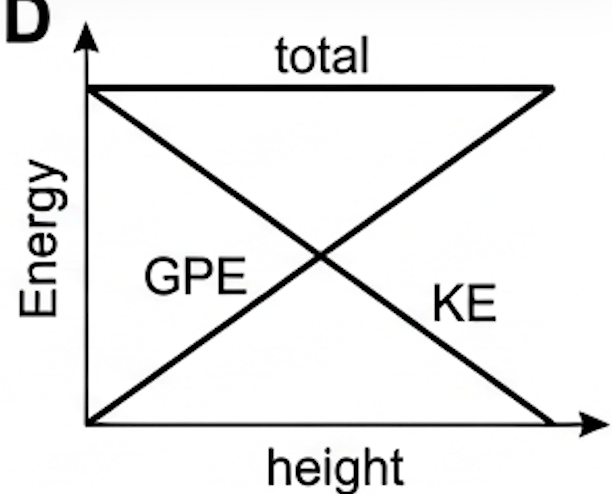
- GPE ⇄ KE. With rest at one end, v = √(2gΔh), independent of mass and path.
- Ideal − real = dissipated. Subtract the real outcome from the ideal prediction to get the energy dissipated.
- Crumple zones. Fs = ½mv²: a larger stopping distance means a smaller force (foam pits, airbags).
- HL: energy gradients. F = −dEp/dx. Equilibrium where Ep–x is flat, stable at a minimum.
Common mistakes
- ✗Friction breaks energy conservation.✓Total energy is conserved; only mechanical energy falls.
- ✗A heavier object lands faster.✓v = √(2gΔh) has no mass.
- ✗Slope length in mgΔh.✓Vertical height only.
- ✗EH = kΔx² or FmaxΔx.✓½kΔx²; average force is half the maximum.
- ✗Not converting cm and g.✓Use m and kg first.
Equations
Ek + Ep + EH = constant
no frictional forces
mgΔh = ½mv² − ½mu²
GPE lost = KE gained
v = √(2gΔh)
from rest, any mass
EH = ½kΔx²
k / N m⁻¹ · Δx / m
F = −dEp/dx
HL · context only
Graphs to know
| Graph | Shape | Read |
|---|---|---|
| F–Δx (Hookean) | straight, gradient k | area = EH |
| F–Δx (real cord) | gradient increases | area = energy; not ½kΔx² |
| Energy–height (ideal) | GPE up, KE down, total flat | conserved |
| Energy–distance (real) | total slopes down | drop = dissipated |
Worked example
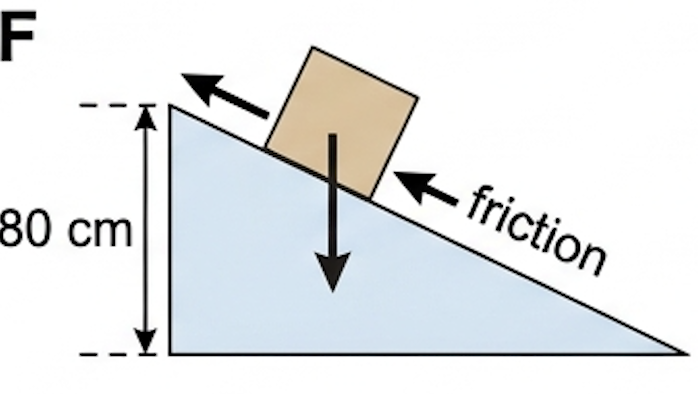
Box sliding down a slope (A3.10)
- m = 4.7 kg, vertical height 0.80 m: ΔEp = 4.7 × 9.8 × 0.80 = 37 J.
- Ideal: 37 = ½(4.7)v² ⟹ v = 4.0 m s⁻¹ (any mass, any slope).
- Measured 2.2 m s⁻¹: dissipated = 37 − ½(4.7)(2.2²) = 26 J, as internal energy.
A3.8 ball thrown up at 23 m s⁻¹: Δh = 27 m. A3.9 spring gun: EH = 0.42 J, Favg = 11 N, v = 10 m s⁻¹.
Key figures