A.2 Forces and Momentum · Lesson 3 of 5 · SL/HL
Friction and Normal Force
A.2 — normal contact force; static and dynamic friction; coefficients of friction. HL: viscous drag (Stokes’s law).
φQ PhysicsRevision sheet
Key ideas
- Friction moves you. Your shoe pushes back on the floor; friction pushes you forward.
- Surface friction. Forces parallel to the contact surface opposing relative or attempted motion. FN acts perpendicular to it.
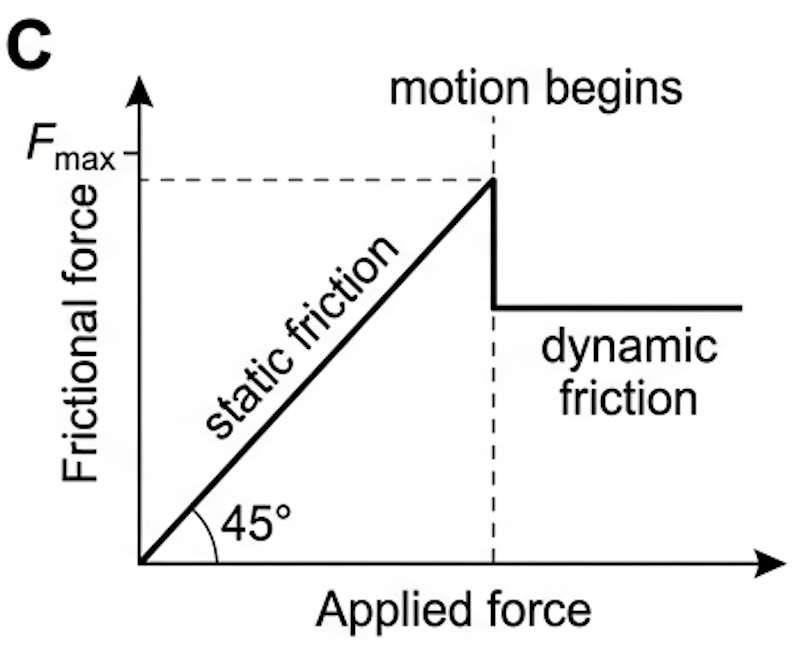
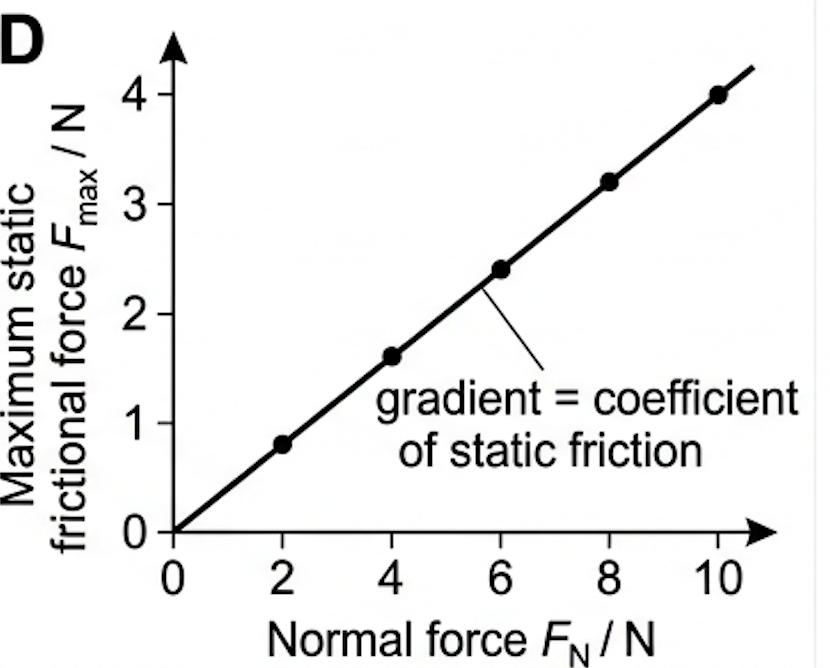
- Static friction. Matches the applied force up to a limiting value Fmax = μsFN.
- Dynamic friction. Once sliding, Ff = μdFN, roughly constant with speed. Usually μd < μs.
- Coefficient μ. No units; describes the pair of surfaces. Contact area does not appear.
- Braking. Maximum braking uses static friction; a skidding tyre uses the smaller μd.
- HL: Stokes’s law. Fd = 6πηrv. At terminal speed Fd + Fb = mg.
Common mistakes
- ✗Bigger contact area, more friction.✓Area cancels out.
- ✗Static friction always = μsFN.✓That is its maximum.
- ✗FN always = mg.✓Only horizontal with no other vertical force.
- ✗Friction always slows things.✓It drives walking and driving.
- ✗Using μs when sliding.✓“Constant speed” means dynamic.
Equations
Ff ≤ μsFN
static friction
Ff = μdFN
dynamic friction
FN = mg
horizontal, no other vertical force
Fd = 6πηrv
HL η viscosity / Pa s · r / m
Fd + Fb = mg
HL terminal speed
Graphs to know
| Graph | Shape | Read |
|---|---|---|
| Ff–applied F | 45° line, drop, flat | peak = μsFN; flat = dynamic |
| Fmax–FN | straight through origin | gradient = μs |
| Ff–v | horizontal | independent of speed |
Worked example
Shifting a wooden crate
- 54 kg box on concrete, μs = 0.3: FN = 54 × 9.8 = 529 N.
- Fmax = 0.3 × 529 = 1.6 × 10² N to break it free.
- 120 N keeps it at constant speed: μd = 120 ÷ 529 = 0.23.
HL: steel ball r = 1.0 mm at 0.050 m s⁻¹ in oil, η = 0.70 Pa s: Fd = 6.6 × 10⁻⁴ N.
Key figures